
By Francesca Cadhit, founder of Top Class Edge Learning, an academic coaching and tutoring practice in Markham serving York Region and GTA families. University of Toronto, HBSc; Governor General’s Academic Medal Recipient; IECA-trained educational consultant; Amazon bestseller author.
“A focused fool can accomplish more than a distracted genius.”
You may have heard this saying before. Whether you agree or not, the point is clear: focus is a key ingredient for success.
As a tutor and academic coach, the challenge I hear more and more with each passing year is that a student can’t seem to focus, despite their best efforts and intentions. Sometimes, a parent describes how a student tries to study, struggles to focus, and ends up with a poor mark. Sometimes, a student confesses that they want to stop putting off assignments until the night before, but have trouble getting started or staying on task.
What interests me is not the observation that a student can’t focus. What interests me is the way it’s said. Parents (and even students) sometimes say it the way you would describe eye colour – almost as if it’s a fixed trait that you either have or don’t.
After more than a decade tutoring and coaching ambitious York Region students, my team and I have observed that focus can improve. We’ve watched it happen in students who had given up on themselves.
But how?
To make progress in anything, we start by identifying the cause. Once we identify it, we make adjustments and track progress to make sure things are headed in the right direction.
When it comes to focus, what I’ll cover in this article are 3 different patterns, with 3 different causes, and 3 different solutions. Families who identify the right one make progress quickly. Families who guess lose a year treating the wrong problem.
Why does homework take my teen three hours instead of one?
Pattern 1: The Multitasker
The short answer: the phone itself isn’t the main problem; the constant switching is. Every toggle between homework and chat charges a re-entry fee on attention, and those fees add up to hours.
What it looks like: Homework technically gets done, but it takes three hours instead of one. Time disappears between chat notifications, doomscrolling, video game breaks, or funny videos. This sets a student up for trouble in multiple ways. First, homework that takes longer than it should eats into time that could otherwise be spent preparing for HOSA, studying for another subject, hockey practice, or many other things. Beyond that, a student who takes longer to solve a math problem at home is a student who struggles to solve a more difficult problem under test conditions, where time is limited, and the pressure is on.
Either way, the tab-switching is the issue that needs to be solved.
What the research says: Many will blame phones or, more broadly, screens, for this multitasking issue. Phones are the popular culprit. Where does the phone sit? Is it facing down? Should it be banished to another room entirely?
But let’s see where the evidence points. A 2025 meta-analysis of 33 studies covering 36,861 people found that the real cost comes from media multitasking: toggling between homework and chat, homework and video, homework and feed. Every toggle charges a re-entry fee on attention.
But, like many things, there’s nuance. When researchers tested heavy multitaskers on objective lab tasks, the differences were surprisingly small. Where the pattern shows up loud and clear is in everyday life: more mind-wandering, more distractibility, more “I read the page, but nothing went in.” That is exactly what parents describe to me during assessment calls.
And the phone’s biggest documented cost to focus doesn’t happen at the desk at all. It happens at bedtime. A JAMA Pediatrics analysis of over 125,000 kids found that using a device at bedtime roughly doubled the odds of inadequate sleep. Even just having the device in the bedroom was linked to worse sleep. Hold that thought, because it leads directly to the next pattern: sleep.
The solution: structure, not surveillance. Frankly, completely banning phones is an unreasonable ask for most. Even in our sessions, students often keep their phones nearby to snap a photo of the whiteboard, and it causes zero problems. Why? Because in a structured session with clear goals and an engaged coach, the phone loses the competition for attention. Alone at a desk at 9 PM with no structure, the phone wins. Same teen. Same phone. Different environment.
So the fix isn’t hovering or confiscating. It’s two structural rules that replace a dozen daily negotiations:
Single-task work blocks
25 to 45 minutes on one subject, one tab, with phone checking batched into the breaks between blocks (not sprinkled through them).
The phone charges outside the bedroom overnight
One rule, applied to the whole family (yes, adults, too).
Why is my teen exhausted and unfocused in first period?
Pattern 2: The Sleep-Deprived Student
The short answer: a teen who starts homework after 10 PM, doesn’t get to sleep until 2 AM, and wakes at 7 AM isn’t unmotivated in the morning. They’re under-slept, and sleep has stronger research behind it than any other focus factor.
What it looks like: First-period classes can be rough. And for good reason. Homework starts late the night before and drags past midnight. Soccer ran long, so dinner happened later, and studying only started after 10 PM. The student isn’t unmotivated at 8 AM the next morning; they’re functionally jet-lagged.
What the research says: When Seattle pushed its high school start times about an hour later, researchers tracked students with wrist-worn sleep monitors. They found that students slept a median of 34 minutes more per night, and median grades rose 4.5%. Thirty-four minutes. That could mean the difference between a high 70 and a low 80 mark.
This isn’t one study. A meta-analysis in Pediatrics covering 28 studies and over 1.7 million participants found the same thing. It sounds obvious, but more sleep was related to better outcomes. And the mechanism matters for teens specifically. Adolescent body clocks genuinely shift later. Your teen staying up isn’t (just) rebellion; it’s biology colliding with an 8 AM bell.
One more finding, because it’s a practical and interesting one. A Korean district that delayed school start times watched sleep gains evaporate within a year as bedtimes drifted later and absorbed the extra morning. In other words, sleep opportunity doesn’t protect itself.
The solution: schedule architecture. You can’t move the school bell. You can control your sleep schedule:
A consistent sleep window
Aim for the same consistent bedtime and wake time. If you like sleeping in on weekends, set the alarm for within an hour of weekdays.
Front-load homework
With the goal of protecting sleep and anticipating tough problem sets that take longer than expected, do work blocks earlier in the afternoon and evening whenever possible.
The September transition plan
Summer sleep schedules don’t fix themselves on Labour Day weekend. Walk bedtime back 15 minutes every few nights starting two weeks before school so that you’ve eased in by the first day back.
Why can my teen focus on video games but not on homework?
Pattern 3: The “Lazy” Gamer Who Isn’t Lazy
The short answer: their attention system works fine. Attention follows structure and reward, and games are engineered to supply both. Homework, as usually assigned, supplies neither.
What it looks like: Four hours of flawless concentration on a game? No problem. Twenty minutes of chemistry? Near impossible. Parents draw the obvious conclusion: he can focus when he wants to. He’s just not trying.
What the research says: This is the pattern I most want to reframe, because the obvious conclusion isn’t pointing anywhere helpful.
The teen brain develops unevenly, on purpose. The reward system matures early and runs hot. Brain-imaging studies find that adolescents tend to show more brain activity in response to rewards than either children or adults, and on behavioural measures, reward-seeking appears to peak around ages 14-15 before declining.
Meanwhile, in teens, research shows that the brain’s reward centre develops ahead of the region that handles judgment and self-regulation. One researcher’s analogy is that it’s like a car with a powerful engine and brakes that haven’t caught up yet.
Games are brilliantly engineered for exactly that brain. They provide instant feedback, clear goals, visible progress, and the next reward always seconds away. Chemistry homework offers none of those. So a teen’s gaming marathon shows us something useful. The attention is there – and it’s going wherever the structure and the rewards are.
The solution: If attention follows structure, build the structure into schoolwork:
Clear session goals
Skip vague instructions like “study chemistry”. Instead, aim for clearer goals, such as “finish and self-check questions 1 through 8.” Clear objectives keep you on track instead of guessing.
Short intervals with visible progress
Checklists, timers, crossing things off. Make progress seen.
Immediate feedback from an accountable human
This is the piece families can’t easily manufacture alone, and it’s where the evidence gets striking. A large randomized trial in Italy found that three hours a week of one-to-one online tutoring raised middle school students’ math performance by about 0.2 standard deviations. To put that into perspective, that’s roughly the size of the pandemic’s average learning loss, reversed. Notably, the tutors were trained university volunteers rather than professional teachers, which suggests the format itself (structure plus an accountable human) is doing much of the work.
This is the pattern our tutoring and coaching practice was built around. During sessions, we build the scaffolding that makes focus possible while the brain’s braking system finishes construction.
I’ll add a brief note here for parents who are wondering about the importance of being okay with being bored sometimes (and not requiring every moment to be “fun”). There’s merit to that, for sure, but we’ll save that for another article, so stay tuned!
Could It Be ADHD? (Read This Before You Self-Diagnose Your Teen)
Some of you have been reading this with a specific question in the back of your mind, so let’s address it directly.
First, let me state upfront that if you have specific questions about ADHD diagnosis or medications, you should talk to your doctor. This is an educational article. That said, having worked with students and families with concerns about this topic, I’ll share what I can within the scope of what my team and I specialize in.
In Canada, ADHD is the most commonly diagnosed long-term condition in children and youth: 8.4% in 2023, up from 6.7% in 2019, though the reasons for that increase aren’t yet settled and greater awareness likely accounts for some of it. Boys are diagnosed at roughly twice the rate of girls (10.8% vs. 5.9%), and the data suggest girls have historically been underdiagnosed, which is worth knowing if you have a daughter who has always been described as “a bit disorganized” rather than disruptive.
There are 3 things worth pointing out:
Hours of intense gaming focus does not rule out ADHD. Reward-driven hyperfocus is common when it comes to ADHD. Research also finds that more severe ADHD symptoms track with a higher risk of problematic gaming, meaning gaming that has become compulsive and disruptive to daily life, not simply a lot of hours logged. What does this mean? “But he can play Fortnite for hours” is not the counterevidence it sounds like.
Distractibility in one setting isn’t diagnostic. A real evaluation looks at symptoms across settings (like home and school), through a professional’s eyes, and not a checklist on the internet or this article.
These are diagnosis rates, not a headcount of who has it. These Canadian figures come from a national survey asking parents whether a child has been diagnosed. Some children who meet criteria have never been assessed, and regional differences may reflect differences in clinical practice as much as differences in the children themselves. Neither the presence nor the absence of a diagnosis in your teen’s classroom tells you much about your own teen.
Which Pattern Is Yours?
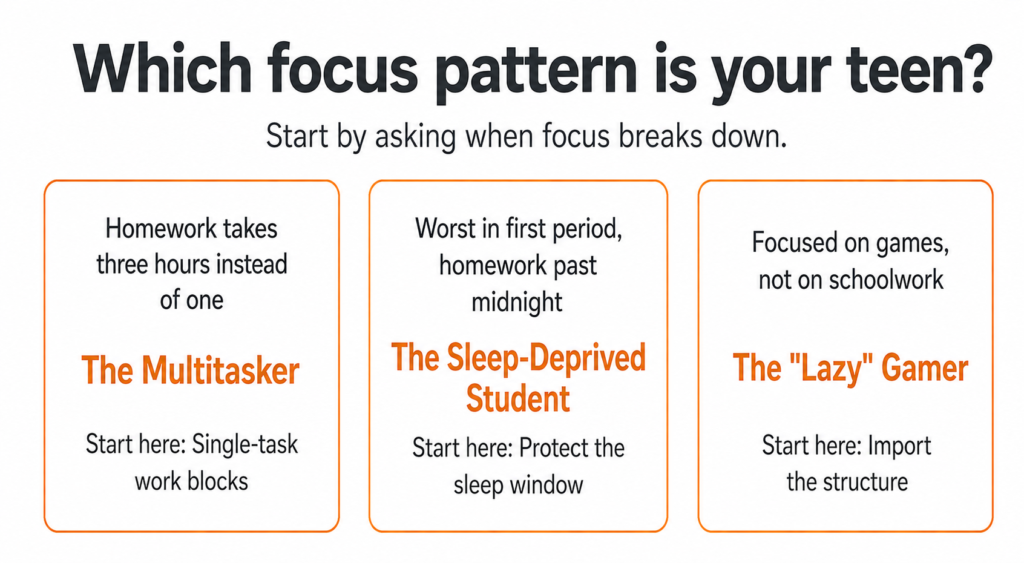
Here’s the diagnostic shortcut. When does focus break down?
- Breaks down during work sessions, everything takes forever → start with Pattern 1, the Multitasker (add guardrails to keep from ineffective multitasking).
- Worst in the mornings, homework drifts past midnight → start with Pattern 2, the Sleep-Deprived Student (protect the sleep window).
- Focus is fine for chosen activities, absent for others → start with Pattern 3, the “Lazy” Gamer (import the structure).
Most students are a blend, but one pattern usually dominates. If a student is sleeping 4 or 5 hours a night, no productivity system on earth will fix their focus. Sleep first, then structure, then support.
Focus isn’t eye colour. It’s not a fixed trait your teen either has or lacks. It’s the output of a system that involves sleep, environment, structure, and accountability. The good news is that systems can be redesigned. September is the time to do it. It’s a fresh start, before the first wave of assessments arrives in October and the year’s story starts writing itself.
Quick Answers for Busy Parents
Can a teenager’s focus actually improve, or is it fixed? It can improve. Focus is the output of a system: sleep, study environment, structure, and accountability. Change the system and focus follows. After more than a decade coaching York Region students, I’ve watched it improve in teens who had written themselves off as “just not focused people.”
Is my teen’s phone causing their focus problems? Partly, but not the way most parents think. The research points to switching (toggling between homework and apps) and to bedtime use, which roughly doubles the odds of inadequate sleep. Two rules help most: single-task work blocks, and the phone charging outside the bedroom overnight.
How much sleep does a high school student need? Sleep experts recommend 8 to 10 hours for teens. Most get significantly less. If a teen is under-slept, fix sleep before trying any study system.
How do I know if it’s ADHD and not just distraction? You don’t, on your own, nor will this article tell you. ADHD evaluation requires a professional looking at symptoms across settings, like home and school. Two useful facts: intense gaming focus does not rule ADHD out, and struggling in only one class or setting doesn’t point to it.
Does tutoring help with focus problems? Tutoring is one of the most tested interventions in education, with a 2024 meta-analysis of dozens of randomized trials finding an average gain of about 0.29 standard deviations. A separate trial found three hours a week of one-to-one online tutoring raised middle schoolers’ math marks. If you ask me, based on my experience, what works is clear goals, immediate feedback, and someone who expects, supports, and challenges you.
When should we start fixing this before school? Start with two weeks before the first day (or earlier, if you can). Walk bedtime back 15 minutes every few nights, re-establish a consistent wake time, and run a few practice work blocks. Waiting until the first bad test result in October means the year’s story has already started writing itself.
If you’d like help identifying which pattern fits your teen or building the structure once you have that, that’s precisely what we do. Call or text Francesca Cadhit at 647-795-0406 or email me at Francesca@TopClassEdge.com to book a 15-minute time to talk it through.
Sources
- Media multitasking and attention: three-level meta-analysis (2025). Current Psychology. https://link.springer.com/article/10.1007/s12144-025-07624-2
- Media multitasking and everyday cognitive functioning: mini meta-analysis. Media Psychology. https://www.tandfonline.com/doi/full/10.1080/15213269.2019.1685393
- Carter et al. (2016). Bedtime media devices and sleep outcomes: meta-analysis. JAMA Pediatrics. https://jamanetwork.com/journals/jamapediatrics/fullarticle/2571467
- Dunster et al. (2018). Sleepmore in Seattle. Science Advances. https://www.science.org/doi/10.1126/sciadv.aau6200
- Yip et al. (2022). School start times, sleep, and youth outcomes: meta-analysis. Pediatrics. https://publications.aap.org/pediatrics/article/149/6/e2021054068/188062/School-Start-Times-Sleep-and-Youth-Outcomes-A-Meta
- Delayed school start time policy study, Korea. https://www.ncbi.nlm.nih.gov/pmc/articles/PMC6157849/
- Galván (2013). The teenage brain: sensitivity to rewards. Current Directions in Psychological Science. https://journals.sagepub.com/doi/10.1177/0963721413480859
- Galván et al. (2006). Earlier development of the accumbens relative to orbitofrontal cortex might underlie risk-taking behavior in adolescents. Journal of Neuroscience. https://pubmed.ncbi.nlm.nih.gov/16793895/
- Engine-and-brakes analogy (accessible explainer). Science News Explores. https://www.snexplores.org/article/search-for-rewards-is-big-driver-in-remodeling-a-teens-brain
- Carlana & La Ferrara (2024). Tutoring Online Program randomized trial. NBER Working Paper 32272 (working paper, not yet peer-reviewed). https://www.nber.org/system/files/working_papers/w32272/w32272.pdf
- Public Health Agency of Canada. Chronic conditions in childhood: Prevalence. Canadian Health Survey on Children and Youth. https://health-infobase.canada.ca/chronic-conditions/childhood/prevalence.html
- Koncz et al. (2023). ADHD symptoms and gaming disorder: systematic review and meta-analysis. Clinical Psychology Review. https://pubmed.ncbi.nlm.nih.gov/37883910/